
Northern white rhinoceros facts for kids
Quick facts for kids Northern white rhinoceros |
|
|---|---|
 |
|
| Angalifu, a male northern white rhinoceros at the San Diego Zoo Safari Park. Angalifu died of natural causes at the age of 44 on 14 December 2014. | |
| Conservation status | |
Scientific classification  |
|
| Kingdom: | Animalia |
| Phylum: | Chordata |
| Class: | Mammalia |
| Order: | Perissodactyla |
| Family: | Rhinocerotidae |
| Genus: | Ceratotherium |
| Species: | |
| Subspecies: |
C. s. cottoni
|
| Trinomial name | |
| Ceratotherium simum cottoni (Lydekker, 1908)
|
|
 |
|
| Extant and assisted colonisation (resident)
Extinct Possibly extinct |
|
The northern white rhinoceros (Ceratotherium simum cottoni), also called the northern white rhino, is a special kind of white rhinoceros. They once lived in many parts of East and Central Africa, south of the Sahara desert. Sadly, since March 19, 2018, only two northern white rhinos are known to be alive. Both are females named Najin and Fatu. This means the subspecies is almost gone, or what scientists call "functionally extinct", because there are no known males left to have babies naturally.
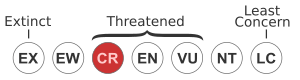
Najin and Fatu are cared for at the Ol Pejeta Conservancy in Kenya, Africa. They originally belong to the Dvůr Králové Zoo in the Czech Republic. They have armed guards protecting them all the time. The International Union for Conservation of Nature (IUCN) said in 2020 that this rhino is "Critically Endangered (Possibly Extinct in the Wild)." This means they are in extreme danger of disappearing forever.
Contents
Understanding the Northern White Rhino
Is it a Species or a Subspecies?
Scientists sometimes debate if the northern white rhino is its own unique species or just a type (a subspecies) of the white rhino. In 2010, some research suggested it might be a separate species, called Ceratotherium cottoni. This was because they found clear differences in their bodies and DNA. These differences showed that northern and southern white rhinos had been living apart for a very long time, maybe even a million years!
However, not all scientists agreed. A study in 2016 looked at their mitochondrial DNA and found they separated between 460,000 and 970,000 years ago. This study concluded that it was better to call them a subspecies. So, for now, it is still considered a subspecies of the white rhino.
The Last Northern White Rhinos
Najin and Fatu: The Remaining Two
Today, only two northern white rhinos are left in the entire world:
- Najin: She is a female born in captivity in 1989. She is the mother of Fatu. Her parents were Nasima and Sudan.
- Fatu: She is also a female, born in captivity in 2000. Her mother is Najin, and her father was Saut.
These two rhinos live in the Ol Pejeta Conservancy in Kenya, Africa. They are originally from the Dvůr Králové Zoo in the Czech Republic. They moved to Kenya on December 20, 2009. Two male rhinos, Suni and Sudan, also came with them. Sadly, Suni passed away in 2014, and Sudan died in 2018. Sudan was the last male northern white rhino.


Protecting the Rhinos
When the rhinos arrived in Kenya, experts watched them closely. They lived in special fenced areas called bomas to help them get used to their new home. The Ol Pejeta Conservancy provides armed guards 24 hours a day to keep them safe.
To protect them even more, their horns were carefully removed. This was done to prevent injuries between the rhinos. More importantly, it made them less attractive to poachers. Poachers are people who illegally hunt animals, often for their valuable horns. Rhinoceros horns are very expensive on the black market. Radio transmitters were put in place of their horns to help track them.
In 2010, Sudan, the male rhino, moved to a much larger, more natural area. He lived there with other African animals, including southern white rhino females. Documentaries, like a BBC special called Last Chance to See, have shared the story of these rhinos.
Challenges in Reproduction
In 2012, Suni and Najin tried to mate. Rhinos are pregnant for 16 to 18 months. By 2014, it was clear Najin was not pregnant. Later, in 2015, tests showed that neither Najin nor Fatu could have babies naturally. Scientists believe Najin might have been pregnant once but lost the baby, which caused problems with her uterus.
Hope for the Future: Assisted Reproduction
Scientists are working hard to save the northern white rhino using advanced methods. In late 2015, experts from several research centers created a plan. They aim to use special cells from the living rhinos and preserved DNA from other northern white rhinos. The DNA of many rhinos is stored in special "genetic banks."
In August 2019, scientists collected ten egg cells from Najin and Fatu. They used frozen sperm from male northern white rhinos who had passed away. This process is called artificial insemination. By September 2019, they successfully fertilized some eggs in a lab, creating two healthy embryos. In January 2020, another embryo was created, all from Fatu's eggs.
These tiny embryos are kept safe in liquid nitrogen. The plan is to place them into a surrogate mother, likely a southern white rhino. In December 2020, more egg cells were taken from Fatu. Eight of these were fertilized, creating two more viable embryos. Najin did not provide any usable egg cells.
As of 2025, the BioRescue team has created 38 northern white rhino embryos. These embryos are stored in labs in Germany and Italy. In 2023, the team successfully put a southern white rhino embryo into a southern white rhino surrogate mother named Curra. Sadly, Curra passed away in November due to a rare infection. Scientists are still working to achieve a successful pregnancy using a northern white rhino embryo.
Where They Once Lived
The Wild Population's Decline
Northern white rhinos once roamed freely across parts of Uganda, South Sudan, the Central African Republic, and the Democratic Republic of the Congo. Their territory might have even reached as far as Chad and Cameroon.
Sadly, poaching caused their numbers to drop dramatically. From about 500 rhinos in the 1970s and 1980s, their population fell to just 15. Although their numbers briefly recovered to over 32 by 2003, poaching increased again. This led to a further decline in the wild population.
The Last Wild Rhinos
The very last known wild northern white rhinos lived in Garamba National Park in the Democratic Republic of the Congo. In 2005, there were only four rhinos found there. Despite efforts to move them to a safer place, this did not happen.
By 2008, scientists believed the species had disappeared from the wild. No rhinos had been seen since 2006, and no signs of them since 2007. One rhino body was found. There was a report in 2009 of rhinos in southern Sudan, but no further sightings confirmed this. So, it is now believed that the wild population is completely gone.
Rhinos in Zoos
At the start of 2015, only two northern white rhinos were left in zoos worldwide. One was in the San Diego Zoo Safari Park in the United States, and the other was in the Dvůr Králové Zoo in the Czech Republic. However, both of these rhinos passed away later that year. Now, no zoos in the world have northern white rhinos.
Dvůr Králové Zoo's Role
The Dvůr Králové Zoo in the Czech Republic played a very important part in the history of these rhinos. In 1975, they received six northern white rhinos from Sudan. They were the only zoo in the world where northern white rhinos successfully had babies. The last calf was born there in 2000. The two rhinos alive today, Najin and Fatu, are descendants of the rhinos from this zoo.

Many rhinos lived at this zoo over the years. Some notable rhinos included:
- Ben, a male born around 1951, who died in 1990.
- Nasima, a female born around 1965, who was the mother of four calves, making her very important for the species. She died in 1992.
- Saut, a male born around 1972, who was the father of Suni and Fatu. He died in 2006.
- Suni, a male born in 1980, who was transferred to Kenya in 2009 and died in 2014.
- Nabire, a female born in 1983, who died in 2015. Scientists tried to use her egg cells for reproduction.
- Sudan, a male born around 1973, who was the father of Najin and Nabire. He was the last known male of the subspecies and passed away in 2018.
In 2009, the Dvůr Králové Zoo sent Suni, Sudan, and the two females (Najin and Fatu) to the Ol Pejeta Conservancy in Kenya. This was a big effort to help the rhinos breed in their natural habitat.
San Diego Zoo Safari Park
The San Diego Zoo Safari Park in California, USA, also cared for northern white rhinos. They had eight wild-caught rhinos over the years.
Some of the rhinos who lived there included:
- Angalifu, a male born around 1973, who died in 2014.
- Nola, a female born around 1974, who died in 2015.
The San Diego Zoo also tried to help with reproduction efforts, but these were not successful.
List of Known Captive Northern White Rhinoceros

| Stud # | Sex | Name | Date of birth | Place of birth | Date of death | Place of death |
|---|---|---|---|---|---|---|
| 15 | M | Paul | 1948-08-07 | Sudan | 1968-04-13 | Antwerp Zoo |
| 16 | F | Chloe | 1948-06-07 | Sudan | 1985-08-07 | Antwerp Zoo |
| 19 | M | Ben | 1950-07-25 | Uganda | 1990-06-25 | Dvůr Králové Zoo |
| 27 | M | Bill | 1954-03-04 | Sudan | 1975-05-02 | San Diego Zoo Safari Park |
| 28 | F | Lucy | 1954-03-04 | Sudan | 1979-03-15 | San Diego Zoo Safari Park |
| 54 | M | [n/a] | 1963-04-01 | Sudan | 1985-12-31 | Riyadh National Zoo |
| 55 | F | [n/a] | 1963-04-01 | Sudan | 1985-12-31 | Riyadh National Zoo |
| 74 | M | Dinka | 1952-07-28 | South Sudan | 1991-01-28 | San Diego Zoo Safari Park |
| 75 | F | Joyce | 1953-01-28 | South Sudan | 1974-08-15 | San Diego Zoo Safari Park |
| 290 | F | Bebe | 1950-07-01 | Uganda | 1964-05-29 | Zoological Society of London |
| 345 | F | Tofacha | 1970-01-01 | Sudan | 1978-09-12 | Al Ain Zoo |
| 347 | M | [n/a] | 1968-04-01 | Sudan | 1978-01-18 | Khartoum Zoo |
| 348 | M | Angalifu | 1972-04-01 | Sudan | 2014-12-14 | San Diego Zoo Safari Park |
| 351 | F | Nasima | 1965-07-01 | Uganda | 1992-08-28 | Dvůr Králové Zoo |
| 372 | M | Sudan | 1973-09-19 | Sudan | 2018-03-19 | Ol Pejeta Conservancy |
| 373 | M | Saut | 1972-09-19 | Sudan | 2006-08-14 | Dvůr Králové Zoo |
| 374 | F | Nola | 1974-09-19 | Sudan | 2015-11-22 | San Diego Zoo Safari Park |
| 375 | F | Nuri | 1973-09-19 | Sudan | 1982-01-04 | Dvůr Králové Zoo |
| 376 | F | Nadi | 1972-09-19 | Sudan | 2007-05-30 | San Diego Zoo Safari Park |
| 377 | F | Nesari | 1972-09-19 | Sudan | 2011-05-26 | Dvůr Králové Zoo |
| 476 | F | Nasi | 1977-11-11 | Dvůr Králové Zoo | 2007-07-20 | Dvůr Králové Zoo |
| 630 | M | Suni | 1980-06-08 | Dvůr Králové Zoo | 2014-10-18 | Ol Pejeta Conservancy |
| 789 | F | Nabire | 1983-11-15 | Dvůr Králové Zoo | 2015-07-27 | Dvůr Králové Zoo |
| 943 | F | Najin | 1989-07-11 | Dvůr Králové Zoo | ||
| 1122 | F | [n/a] | 1991-07-18 | Dvůr Králové Zoo | 1991-07-18 | Dvůr Králové Zoo |
| 1123 | F | [n/a] | 1963-04-01 | Sudan | 1967-08-02 | Khartoum Zoo |
| 1252 | ? | [n/a] | 1948-11-17 | Sudan | 1949-01-29 | Khartoum Zoo |
| 1305 | F | Fatu | 2000-06-29 | Dvůr Králové Zoo |
Population Chart
| Location | 1909 | 1960* | 1975* | 1984 | 1995 | 1996 | 1998 | 2000 | 2003 | 2006 | 2007 | 2008 | 2009 | 2011 | 2014 | 2015 | 2017 | 2018 | 2019 |
|---|---|---|---|---|---|---|---|---|---|---|---|---|---|---|---|---|---|---|---|
| Wild | 2,000–3,000* | 2,000* | 500* | 15 | 35 | 29 | 26–31 | 30–36 | 30 | 4 | n/a | 0 | 0 | 0 | 0 | 0 | 0 | 0 | 0 |
| Central African Republic | n/a | n/a | n/a | 0 | 0 | 0 | 0 | 0 | 0 | 0 | 0 | 0 | 0 | 0 | 0 | 0 | 0 | 0 | |
| Dem. Republic of Congo | n/a | n/a | n/a | 15 | 35 | 29 | 26–31 | 30–36 | 30 | 4 | n/a | 0 | 0 | 0 | 0 | 0 | 0 | 0 | 0 |
| South Sudan | n/a | n/a | n/a | 0 | 0 | 0 | 0 | 0 | 0 | 0 | 0 | 0 | 0 | 0 | 0 | 0 | 0 | 0 | |
| Uganda | n/a | n/a | n/a | 0 | 0 | 0 | 0 | 0 | 0 | 0 | 0 | 0 | 0 | 0 | 0 | 0 | 0 | 0 | |
| Captivity | n/a | 7 | 15 | 16 | 11 | 10 | 10 | 11 | 11 | 10 | 8 | 8 | 8 | 7 | 5 | 3 | 3 | 2 | 2 |
| Dvůr Králové Zoo, Czech Republic |
n/a | 0 | 6 | 9 | 6 | 6 | 7 | 8 | 8 | 7 | 6 | 6 | 2 | 1 | 1 | 0 | 0 | 0 | 0 |
| Khartoum Zoo, Sudan | n/a | 0 | 2 | 1 | 0 | 0 | 0 | 0 | 0 | 0 | 0 | 0 | 0 | 0 | 0 | 0 | 0 | 0 | 0 |
| Ol Pejeta Conservancy, Kenya |
n/a | 0 | 0 | 0 | 0 | 0 | 0 | 0 | 0 | 0 | 0 | 0 | 4 | 4 | 3 | 3 | 3 | 2 | 2 |
| San Diego Zoo, USA | n/a | 0 | 2 | 1 | 5 | 4 | 3 | 3 | 3 | 3 | 2 | 2 | 2 | 2 | 1 | 0 | 0 | 0 | 0 |
| Other zoo faculties | n/a | 7 | 5 | 5 | 0 | 0 | 0 | 0 | 0 | 0 | 0 | 0 | 0 | 0 | 0 | 0 | 0 | 0 | 0 |
| Total | 2,000–3,000* | 2,000* | 500* | 31 | 46 | 39 | 36–41 | 41–47 | 41 | 14 | 8 | 8 | 8 | 7 | 5 | 3 | 3 | 2 | 2 |
*estimate
Images for kids
-
Northern white rhinos
.svg)
See also
 In Spanish: Rinoceronte blanco del norte para niños
